
Refillable Ink Tank vs Cartridge Printer: If you’ve ever stood in a supermarket aisle staring at a replacement ink cartridge and winced at the price, you’re not alone. Ink is one of those hidden costs of home and office printing that catches most people off guard. It’s almost a running joke at this point – you buy what seems like a reasonably priced printer, only to find yourself spending more on ink every few months than you did on the machine itself.
That’s exactly why refillable ink tank printers have started turning heads. But are they actually worth the switch? And what’s the real difference between the two?
Let’s break it all down, honestly and without the marketing fluff.
Refillable Ink Tank vs Cartridge Printer
How Each System Works
Before we get into the pros and cons, it helps to understand what we’re actually comparing.
Cartridge printers are the traditional setup most of us grew up with. The ink sits inside small plastic cartridges that slot into the printer. When one runs out, you pull it out and pop a new one in. Simple, familiar, and widely available but as anyone who prints regularly will tell you, the costs add up fast.
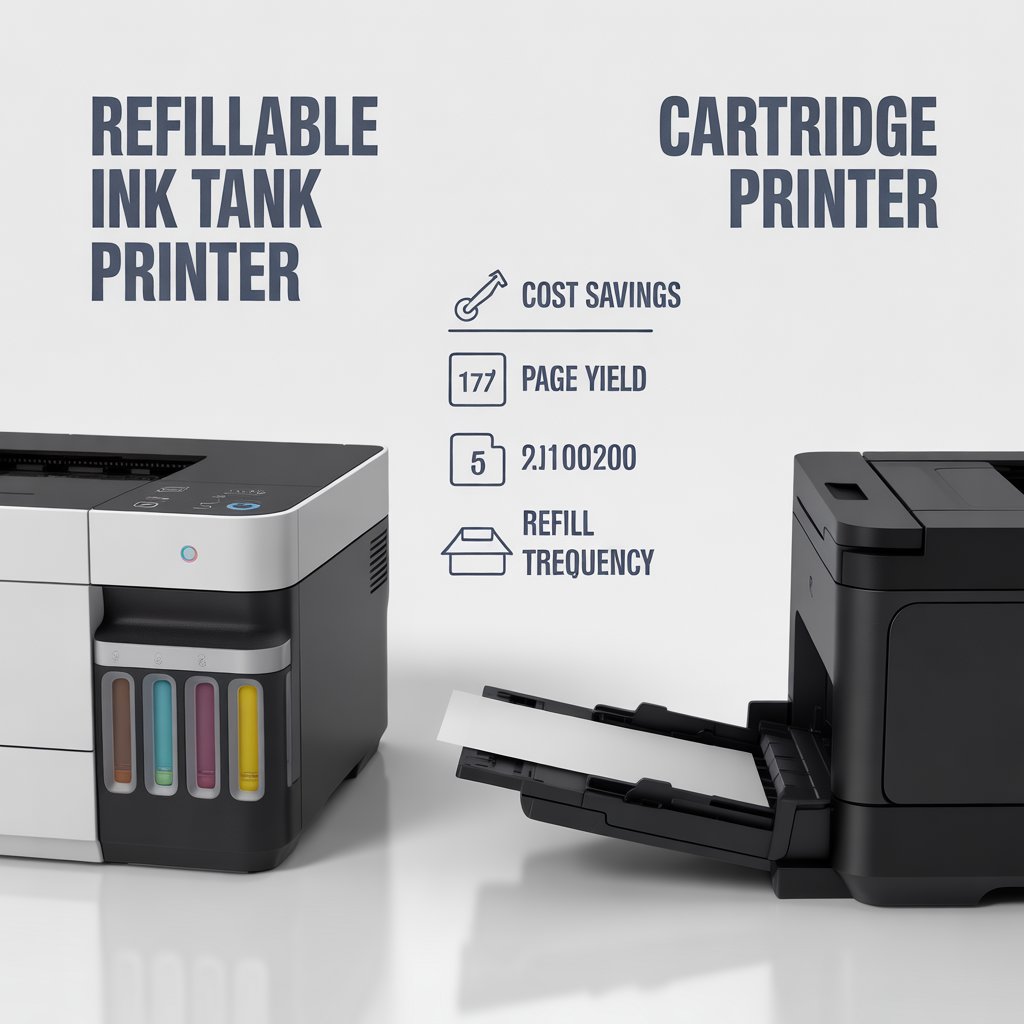
Refillable ink tank printers, like the Epson EcoTank and ET Series range, work differently. Instead of cartridges, they have large built-in ink reservoirs tanks – that sit on the side or front of the printer, clearly visible. When your ink runs low, you pour in a new bottle of ink directly into the tank. No fuss, no cartridges to dispose of, and significantly more ink per fill.
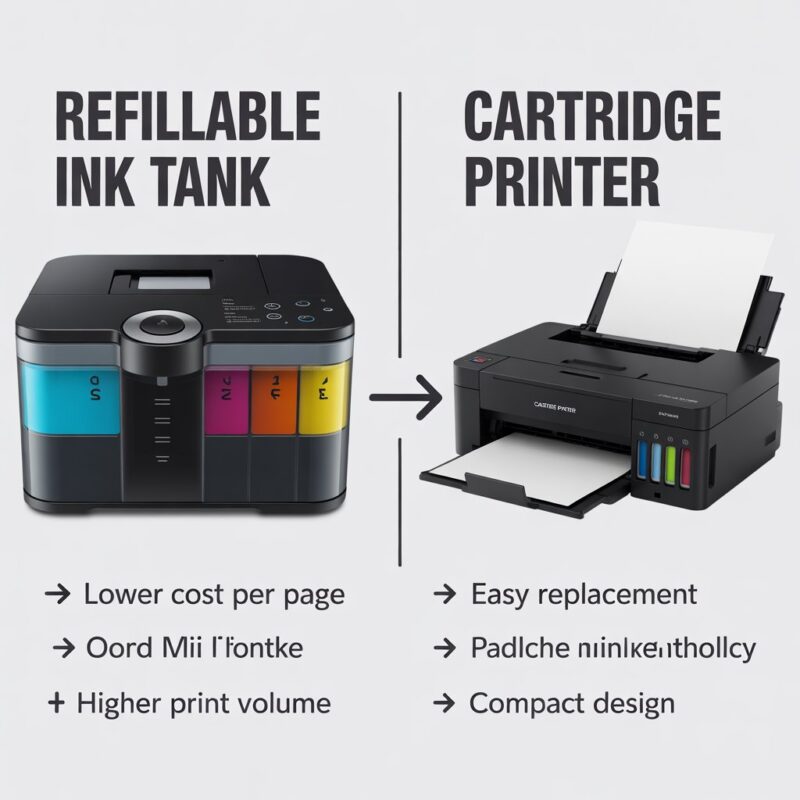
The Epson ET Series, for example, is built around this tank system. Models like the ET-2850 and ET-4856 are popular in UK households and small offices precisely because they cut out the cartridge middleman entirely.
The Real Cost of Printing
This is where things get interesting – and where the two systems really start to diverge.
Cartridge printers are typically cheaper upfront. You can pick up a decent model for under £60. But the cartridges themselves? A set of four colour cartridges from a major brand can easily set you back £25–£40, and depending on your print volume, you might be replacing them every few weeks.
Refillable ink tank printers cost more to buy. A mid-range Epson ET Series printer in the UK typically sits between £250 and £350. That’s a bigger initial investment, no question. But the ink? A whole different story.
With compatible Epson 104 ink bottles — like the ones we stock here at Cynopack — you’re getting a full multipack of four bottles (black, cyan, magenta, and yellow) for a fraction of what you’d spend on cartridges over the same period. Each bottle holds significantly more ink than a standard cartridge, and when you do the sums over a year of regular printing, the savings are considerable.
To put it plainly: if you print more than a few pages a week, a refillable ink tank printer will likely pay for itself within the first year.
Print Quality: Is There a Difference?
This is a question we hear a lot, and the honest answer is: not really — or at least, not in any way most people would notice day-to-day.
Modern ink tank printers, including the Epson ET Series, produce excellent quality prints. Documents come out sharp and professional, and photo prints are vibrant and well-defined. For home use, school projects, general office documents, and even small business materials, the quality is more than adequate.
Where you might notice a very subtle difference is in specialist photography printing at extremely high resolutions. In those niche scenarios, dedicated photo printers with premium cartridge inks might edge slightly ahead. But for the overwhelming majority of what people actually print? Ink tank printers hold their own comfortably.
One thing to be aware of: the quality of the ink you use does matter. Compatible inks need to be specifically formulated for your printer model. The Cynopack compatible Epson 104 ink bottles are designed to work seamlessly with ET Series printers, delivering consistent colour accuracy and page yield without damaging the print heads.
Convenience: Day-to-Day Printing Life
Let’s be real about convenience, because it cuts both ways.
Cartridge printers win on initial simplicity. Swapping a cartridge is quick, clean, and takes about thirty seconds. There’s nothing to pour, no risk of spillage, and the whole thing feels very plug-and-play.
Ink tank printers take a small amount of care. Refilling the tanks is straightforward once you’ve done it once, but it does involve carefully pouring ink from a bottle. Most modern ink bottles, including the Epson 104 format, have a nozzle tip designed to make this clean and precise — but it’s still a slightly more involved process than snapping in a cartridge.
That said, here’s the trade-off: with a cartridge printer, you might be doing that cartridge swap every few weeks. With an ink tank printer, a single set of bottles can last months – sometimes the better part of a year for moderate users. Many people find that the infrequency of refilling more than makes up for the slight extra care involved.
There’s also the question of availability. If you run out of cartridges on a Sunday evening when the shops are shut, you’re stuck. With an ink tank printer and a spare set of bottles in the cupboard, you’re always covered.
Environmental Impact
This is a topic that matters more and more to consumers in the UK, and rightly so.
Cartridge printers generate a significant amount of plastic waste. Every used cartridge needs to be disposed of — ideally recycled, though many still end up in landfill. Even with recycling schemes, the sheer volume of plastic involved across millions of households adds up.
Ink tank printers dramatically reduce this waste. Instead of dozens of cartridges a year, you’re using a handful of small ink bottles. The plastic footprint is considerably lower, and the packaging for bottled ink is generally less elaborate than cartridge blister packs.
If reducing your environmental impact is part of your decision-making, this is a meaningful point in favour of ink tank printing.
Who Should Buy a Cartridge Printer?
Cartridge printers still make sense for some people, and there’s no point pretending otherwise.
If you print very rarely – perhaps only a few times a month, or even less – then the upfront cost of an ink tank printer is harder to justify. Very light users might find that a cheaper cartridge printer, topped up occasionally, works out fine financially. It’s also worth noting that cartridge printers tend to be more compact, which can be a factor if desk space is tight.
There’s also the matter of specialist inks. If you need a printer for specific tasks like printing on photo paper, fabric, or with waterproof inks, some cartridge-based systems offer more variety in ink types.
Who Should Buy a Refillable Ink Tank Printer?
If you print regularly — whether at home, for a small business, or for school — a refillable ink tank printer is almost certainly the smarter choice for the long term.
The Epson ET Series ticks a lot of boxes for UK buyers: solid build quality, reliable wireless connectivity, good print speeds, and the kind of running costs that won’t make you wince every time you open a new pack of ink.
Paired with compatible ink bottles like the ones available from Cynopack, you’re looking at an affordable, low-waste, high-volume printing setup that does what you need without constantly draining your wallet.
The Cynopack Compatible Epson 104 Ink Bottles
If you already own an Epson ET Series printer — or you’re planning to buy one — keeping it stocked with the right ink is the key to getting the most out of it.
Our Cynopack compatible Epson 104 ink bottles (multipack, 4 pack) are designed specifically for the EcoTank and ET range. You get all four colours in one order, with ink formulated to deliver accurate colours, clean text, and reliable page yields. It’s a straightforward, cost-effective way to keep your printer running without overspending on branded consumables.
“If you’ve recently refilled your EcoTank and are having issues, see our guide: Epson EcoTank Not Printing After Refill – How to Fix It”
Final Thoughts
The choice between a refillable ink tank printer and a cartridge printer really comes down to how much you print and how long you’re thinking ahead.
If you’re buying a printer for occasional use and want to spend as little as possible right now, a cartridge printer does the job. But if you’re printing with any regularity, the maths increasingly favour the ink tank system — lower running costs, less plastic waste, and fewer frustrating moments when you realise you’ve run out of cyan at the worst possible time.
For most households and small businesses in the UK, the Epson ET Series combined with a reliable supply of compatible ink is hard to beat. The higher upfront price is an investment that pays back quickly, and from there, printing becomes considerably less of a headache.
Looking for compatible ink for your Epson ET Series printer? Browse our Cynopack Epson 104 ink bottle multipack and keep your printer running smoothly.