
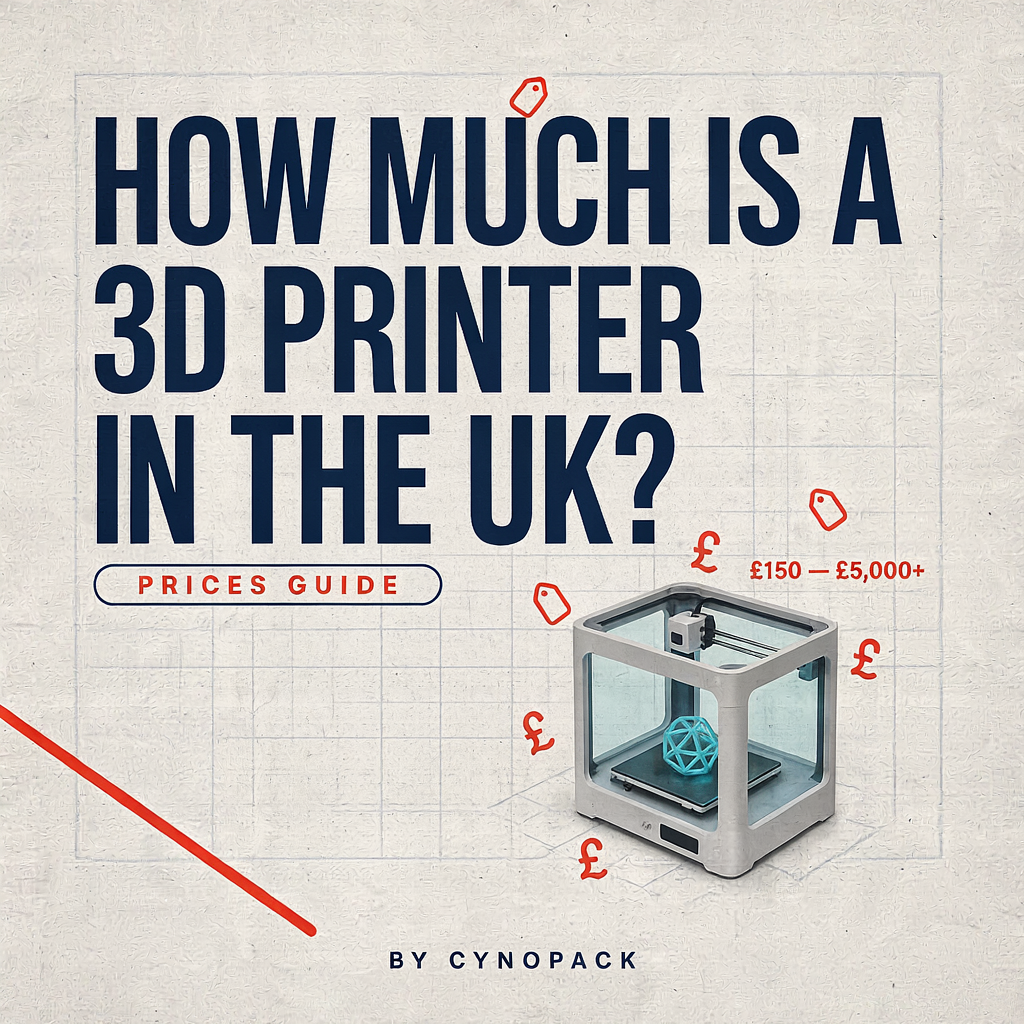
How much is a 3D printer in the UK? A basic home 3D printer typically costs around £150 to £300, while a better-equipped beginner or hobby machine commonly falls between £300 and £600. Enthusiast models can cost £600 to £1,200, and professional desktop systems often start at approximately £1,500 and can exceed £5,000.
The machine is only part of the budget. You may also need filament or resin, tools, replacement parts, finishing equipment and suitable ventilation. A realistic starting budget is therefore usually higher than the advertised printer price.
This guide explains current UK price ranges, the difference between filament and resin printers, expected running costs and how to decide whether buying a 3D printer is worthwhile.
How Much Is a 3D Printer in the UK
3D Printer Prices in the UK at a Glance
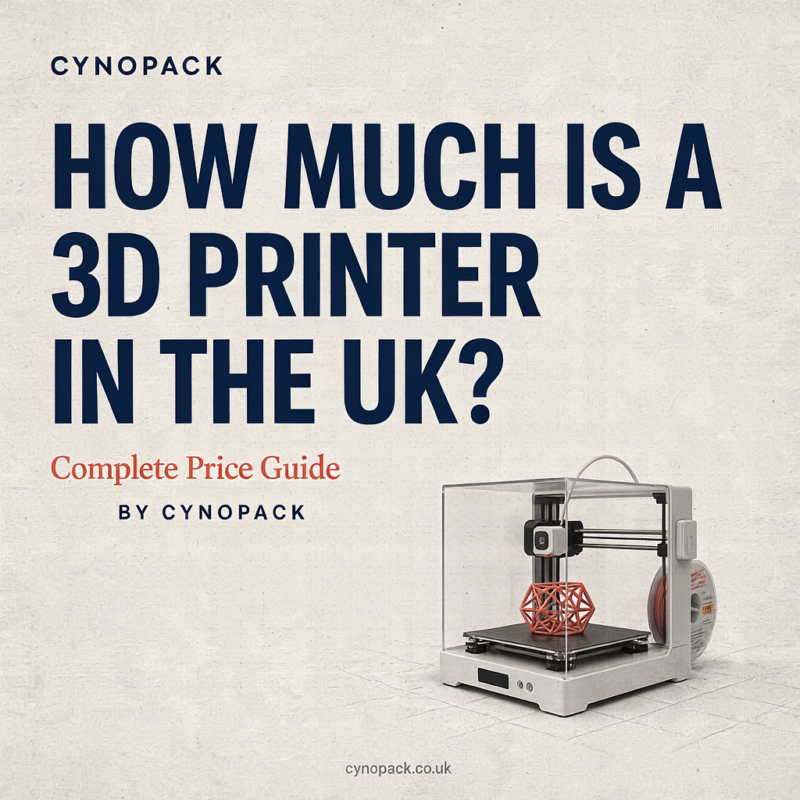
The following ranges are useful planning estimates rather than fixed retail prices. The price of a particular machine can change with promotions, bundles, delivery charges and VAT treatment.
| Type of 3D printer | Typical UK price | Usually suitable for |
|---|---|---|
| Basic beginner FDM printer | £150–£300 | Learning, small models and occasional hobby use |
| Better beginner or home FDM printer | £300–£600 | Easier setup, faster printing and regular home use |
| Enthusiast FDM printer | £600–£1,200 | Larger projects, advanced materials and frequent use |
| Entry-level resin printer | £180–£400 | Miniatures and small, detailed models |
| Advanced resin printer | £400–£1,500 | Larger build areas, higher productivity and detailed work |
| Professional desktop printer | £1,500–£5,000+ | Design studios, engineering and business prototyping |
| Professional powder-based system | £10,000–£50,000+ | Specialist functional parts and commercial workflows |
| Industrial 3D printer | £50,000–£500,000+ | Manufacturing, certified processes and industrial production |
These categories overlap. A more expensive printer is not automatically the best choice: the right machine is the one that matches the required material, part size, detail, reliability and workload.
How Much Should a Beginner Spend on a 3D Printer?
For most UK beginners, £200 to £500 is a sensible budget for an FDM printer. Within this range, you can find machines with helpful features such as automatic bed levelling, removable build plates, filament-runout detection and guided calibration.
It is possible to spend less, but the cheapest machines may require more manual adjustment, assembly and troubleshooting. A first-time buyer should consider ease of use, spare-part availability, documentation and manufacturer support—not just print speed or the lowest headline price.
If you want to print gaming miniatures, jewellery prototypes or other small objects with very fine detail, a resin printer may be more appropriate. Allow for washing, curing, gloves, consumables and ventilation in addition to the printer itself.
What Is the Real Starting Cost?
The checkout price rarely represents the complete cost of starting 3D printing.
| Initial expense | FDM setup | Resin setup |
|---|---|---|
| Printer | £150–£500 | £180–£500 |
| First supply of material | £15–£30 | £20–£50 |
| Basic tools and spare parts | £20–£80 | £30–£100 |
| Finishing or post-processing equipment | £10–£50 | £80–£250 |
| Indicative starting total | £195–£660+ | £310–£900+ |
An FDM printer may include enough filament for a test model but not a full 1kg spool. A resin package may or may not include a wash-and-cure station. Always check exactly what is included before comparing offers.
FDM 3D Printer Costs
FDM, or fused deposition modelling, is the most common form of home 3D printing. It heats plastic filament and deposits it layer by layer.
An entry-level FDM printer can cost from approximately £150, while more automated and faster home models commonly cost £300 to £600. Larger, enclosed or multi-material machines can cost considerably more.
FDM is generally a practical choice for:
- Household organisers and simple replacement pieces
- Prototypes and workshop aids
- Educational projects
- Cosplay components
- Toys, models and decorative objects
- Low-volume products where visible layer lines are acceptable
PLA is often the easiest starting material. PETG can provide greater toughness and temperature resistance, while materials such as ABS, ASA, nylon and fibre-filled filaments may need an enclosure, ventilation, hardened components or more careful settings.
Resin 3D Printer Costs
Consumer resin printers commonly cost £180 to £500, although larger or more advanced units can reach £1,500 or more. They create highly detailed parts by curing liquid photopolymer resin.
The phrase “resin printer” is more accurate for general buying guidance than using “SLA” for every model. Many affordable desktop machines use a masked LCD process, while traditional stereolithography systems use a different light-delivery method.
Resin printers are popular for:
- Tabletop miniatures
- Detailed display models
- Jewellery and dental workflows using application-specific systems and materials
- Small prototypes with fine surface detail
Budget for more than resin. A safe and practical workflow may require nitrile gloves, eye protection, washing liquid, sealed storage, cleaning materials, replacement vat films and a curing station. Uncured resin must be handled according to the manufacturer’s safety instructions and kept away from children and pets.
Professional and Industrial 3D Printer Prices
Professional desktop printers typically prioritise repeatability, material profiles, service support and workflow management. They can range from around £1,500 to more than £5,000. For example, Formlabs listed its Form 4 Basic Package at £2,610 including VAT when this guide was updated, although current pricing should always be checked before purchase.
Powder-based systems and industrial machines cost much more because the printer may be only one component of a controlled production process. Extraction, material-handling equipment, post-processing, service contracts, training and facility changes can substantially increase the total investment.
Businesses should request a complete quotation rather than comparing machine prices alone.
How Much Do 3D Printing Materials Cost?
Filament prices
A standard 1kg spool of everyday PLA or PETG often costs around £15 to £30. Specialist, engineering or composite materials can cost £40 per kilogram or considerably more.
The material cost of a part depends on its weight rather than how long the printer runs. If a model uses 120g of filament from a £20 spool, the raw filament cost is:
0.12kg × £20 = £2.40
Supports, purge material, calibration prints and failures increase real consumption.
Resin prices
General-purpose resin commonly costs approximately £20 to £50 per litre. Specialist resins designed for toughness, high temperature, casting or professional applications may be significantly more expensive.
Resin users should also account for washing liquid, gloves, filters, cleaning materials and replacement vat films. Some resin remains on supports and printed surfaces, so not every millilitre becomes part of the finished object.
How Much Electricity Does a 3D Printer Use?
Electricity cost depends on the printer’s average power draw, print duration and your electricity tariff. A printer does not necessarily use its maximum rated wattage continuously.
Using the Ofgem average electricity unit rate of 26.11p per kWh for 1 July to 30 September 2026, the approximate hourly costs are:
| Average power draw | Approximate electricity cost per hour |
|---|---|
| 50 watts | 1.3p |
| 100 watts | 2.6p |
| 150 watts | 3.9p |
| 300 watts | 7.8p |
| 500 watts | 13.1p |
For example, a printer averaging 100 watts during an eight-hour job would use 0.8kWh:
0.1kW × 8 hours × £0.2611 = approximately £0.21
Your actual tariff and the machine’s measured consumption may differ. A plug-in energy monitor can provide a more useful figure for your own setup.
How Much Does One 3D Print Cost?
A practical calculation is:
Material + electricity + failed-print allowance + maintenance + labour + finishing
Consider an eight-hour FDM print weighing 120g:
- Filament from a £20/kg spool: £2.40
- Electricity at an average 100W and 26.11p/kWh: about £0.21
- Basic direct cost before waste: about £2.61
That £2.61 is not the complete commercial cost. It excludes design time, machine setup, failed prints, wear, packaging, selling fees, tax and the time spent removing supports or finishing the object.
Other Costs Buyers Often Miss
Before choosing a printer, allow for:
- Failed prototypes and calibration prints
- Nozzles, build surfaces and other wear parts
- Adhesives, cutters, scrapers and measuring tools
- Resin vats, vat film, filters and washing supplies
- Dry storage for moisture-sensitive filament
- Ventilation or an enclosure where required
- Sanding, priming, painting and other finishing materials
- Design or slicing software subscriptions where applicable
- Packaging, marketplace fees and postage for sold items
- Time spent learning, maintaining and troubleshooting
- VAT, import charges or delivery fees where not included
Free software is available, so a paid licence is not essential for every user. Slicers such as Cura, PrusaSlicer, Bambu Studio and OrcaSlicer prepare models for printing. CAD and modelling programs—including Tinkercad, FreeCAD, Blender, Fusion and Onshape—are used to create or modify designs. Licence terms and free-plan eligibility can change, particularly for business use.
Are Cheap 3D Printers Worth Buying?
A low-cost printer can be worthwhile if you enjoy learning and are comfortable with calibration and maintenance. It may be less suitable if you need predictable output immediately or cannot spend time diagnosing failed prints.
Look beyond advertised speed and resolution. Check:
- Whether the machine arrives assembled
- Bed-levelling and calibration features
- Replacement-part availability
- Noise, footprint and ventilation needs
- Material compatibility
- Independent documentation and user support
- Warranty terms and UK service arrangements
Paying more can buy convenience and consistency, but it does not remove the need to learn basic printing and maintenance.
Is a 3D Printer Worth It for Home Use?
A home 3D printer can be worthwhile when you have repeat uses for it: making organisers, project enclosures, prototypes, models or non-critical replacement items. Its value is lower if you expect to print only once or twice a year.
Buying also makes sense for people who enjoy design and experimentation. The ability to revise a part and print another version at home may be more valuable than the cash saving alone.
Outsourcing is often the better choice for occasional work, unusually large components or projects that require a specialist material or process.
Can You Make Money with a 3D Printer in the UK?
It is possible, but revenue is not the same as profit. Use a transparent break-even calculation rather than assuming every sale quickly pays for the printer.
For example:
| Item | Example amount |
|---|---|
| Printer and initial equipment | £450.00 |
| Selling price per item | £12.00 |
| Filament | £0.80 |
| Electricity | £0.10 |
| Packaging | £0.60 |
| Selling/payment fees | £1.50 |
| Contribution before labour and tax | £9.00 |
At £9 contribution per item, approximately 50 sales would recover £450 of equipment cost. This simplified example does not include design work, failed prints, maintenance, customer service, returns, insurance or tax.
Commercial sellers should also check intellectual-property licences and relevant UK product-safety obligations. Do not sell downloaded designs unless their licence permits commercial use.
Important Safety and Suitability Considerations
3D-printed parts are not automatically suitable for every task. Layer adhesion, material choice, print orientation, heat, UV exposure and repeated loading can all affect strength.
Do not rely on an untested printed component for critical electrical, gas, medical, fire-safety, food-contact or load-bearing applications. Use an appropriately engineered and certified product where failure could cause injury, contamination or property damage.
Follow the printer and material manufacturer’s ventilation, temperature, protective-equipment and disposal guidance. Resin needs particularly careful handling before it is fully cured.
Buying a 3D Printer Versus Using a Printing Service
Consider buying when you:
- Expect to print regularly
- Want to iterate designs quickly
- Are willing to learn setup and maintenance
- Need control over scheduling and materials
Consider outsourcing when you:
- Need only a few parts
- Require a specialist industrial process
- Need a build size or material beyond a desktop machine
- Do not have suitable space or ventilation
- Want a finished part without owning and maintaining equipment
There is no reliable universal “starting price” for a printing service. Quotations depend on dimensions, material, process, resolution, finish, quantity, design preparation, VAT and delivery. Request like-for-like quotes using the same model file and specifications.
How to Choose the Right 3D Printer
Start with the object you want to make, not a particular brand.
- Choose the process. FDM is practical for many functional and larger home projects; resin is useful for fine detail.
- Check the required build volume. A large model may be divided into pieces, but that creates assembly and finishing work.
- Identify the material. Confirm the printer supports the material and temperatures you need.
- Decide how much setup you accept. Automation can make first prints easier, although every machine needs maintenance.
- Check the full cost. Include consumables, tools, post-processing, delivery and replacement parts.
- Review support. Good documentation, available spares and a clear warranty can matter more than a small price difference.
- Plan a safe location. Consider heat, moving parts, fumes, noise, children and pets.
Frequently Asked Questions
How much is a basic 3D printer in the UK?
A basic FDM printer usually costs approximately £150 to £300. The lowest-priced machines may require assembly and manual calibration, while models nearer the top of this range may include automatic levelling and other convenience features. Budget for filament and basic tools as well as the machine.
How much should I spend on my first 3D printer?
Around £200 to £500 is a sensible FDM budget for many beginners. Choose according to the required build size, materials, support and ease of use. For resin printing, include washing, curing, protective equipment and ventilation when calculating the budget.
How much does a resin 3D printer cost?
Entry-level resin printers generally cost about £180 to £400, with larger or more advanced consumer systems ranging from £400 to £1,500 or more. A complete resin setup normally costs more than the printer price because safe washing and curing equipment is also needed.
What is the cheapest type of 3D printer?
FDM is generally the cheapest and simplest route into 3D printing when equipment, materials and post-processing are considered together. Small resin printers can also have low purchase prices, but resin handling and finishing add to the total cost.
How much does 3D-printer filament cost?
Everyday PLA or PETG often costs around £15 to £30 for a 1kg spool. Specialist materials can exceed £40 per kilogram. Compare diameter, material, colour, spool weight and compatibility rather than choosing on price alone.
How much does 3D-printer resin cost?
General-purpose resin commonly costs roughly £20 to £50 per litre. Engineering, casting and other specialist formulations can cost considerably more. Include gloves, washing supplies, filters and replacement vat film in the running budget.
Do 3D printers use a lot of electricity?
Small desktop printers usually use less electricity than their material cost might suggest, but consumption varies. At 26.11p/kWh, a machine averaging 100W costs about 2.6p per hour. Heated beds, enclosures and larger machines may use more.
How much does a 10-hour 3D print cost in electricity?
A printer averaging 100W would use 1kWh over ten hours, costing about 26p at a rate of 26.11p/kWh. A 300W average would cost about 78p. Measure the actual printer if precise costing is important.
Is a cheap 3D printer worth it?
It can be if you enjoy practical troubleshooting and do not require immediate, repeatable production. For someone who values guided setup, reliability and support, a better-equipped beginner machine may provide better overall value than the cheapest option.
Can I make money with a 3D printer in the UK?
Yes, but profit depends on demand, pricing and full costs. Account for material, electricity, failures, labour, packaging, fees, returns and tax. You must also have commercial rights to designs and comply with any relevant product-safety rules.
Do I need a computer to use a 3D printer?
You generally need a phone, tablet or computer for setup, downloading models or preparing print files. Some printers can start jobs from local storage or an app once the file has been prepared, but their workflows vary.
What extra equipment do I need?
FDM users may need cutters, scrapers, spare nozzles and filament storage. Resin users also need protective gloves, washing and curing equipment, cleaning supplies and a suitable ventilated workspace. Check the manufacturer’s instructions for the chosen material.
Is FDM or resin better for beginners?
FDM is often easier for general home projects and involves simpler material handling. Resin can produce finer detail but requires more careful safety and post-processing procedures. Choose based on the parts you want to make rather than detail specifications alone.
Should I buy a printer or outsource my parts?
Buy if you expect frequent use and value rapid experimentation. Outsource if you need only occasional parts, specialist materials or professional finishing. Compare the total ownership cost with quotations for the same design and specification.
How long does a 3D printer last?
There is no fixed lifespan. A maintained desktop printer can remain useful for several years, while nozzles, build surfaces, belts, fans, screens and resin vat films are consumable or replaceable parts. Usage, environment, maintenance and spare-part support all affect longevity.
Final Verdict: Is a 3D Printer Worth the Cost?
For most UK beginners, the realistic answer to “how much is a 3D printer?” is £200 to £500 for a suitable FDM machine, plus materials and tools. A practical starter setup may total £195 to £660 or more, while a resin setup may cost £310 to £900 or more once post-processing equipment is included.
A printer can be worthwhile for regular projects, iterative design, education or a properly costed small business. If you only need a few parts, outsourcing may offer better value and less risk.
Compare total ownership cost, choose a process suited to your intended parts and plan for safe use. That will tell you far more than the printer’s headline price alone.